A Plea for Peace Amidst the Rain and Rubble

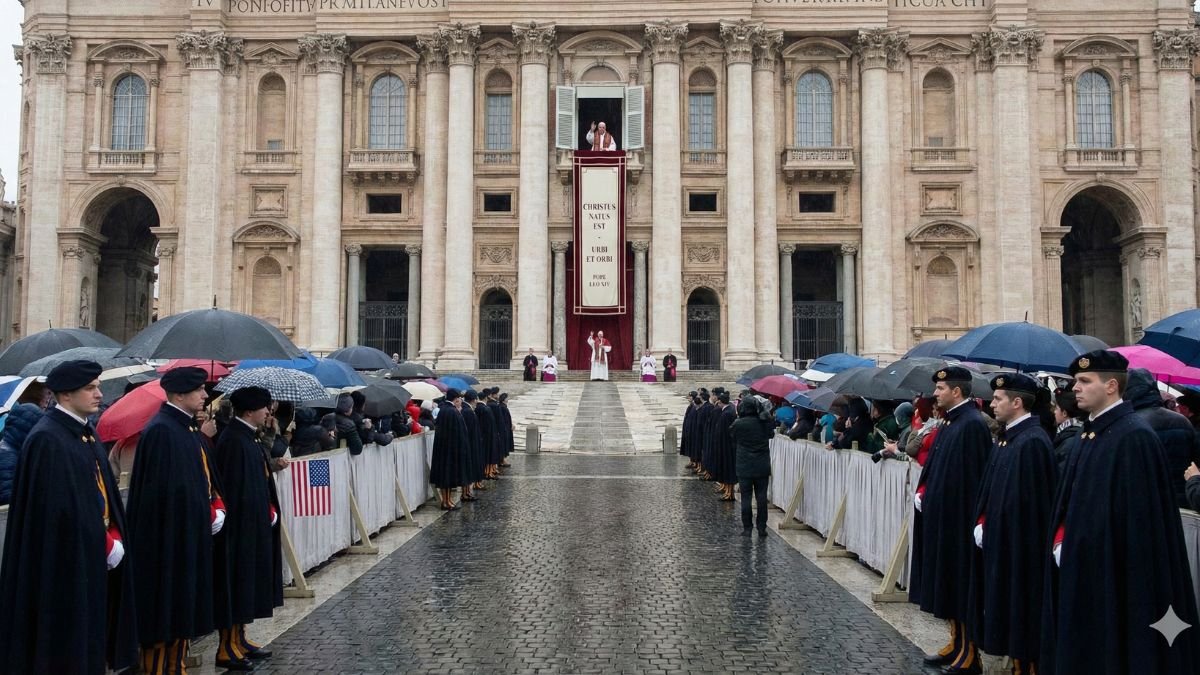
VATICAN CITY, Dec. 25 – Rain lashed St. Peter’s Square this morning, a gray and somber backdrop for a historic moment: the first Christmas “Urbi et Orbi” blessing delivered by an American pope. Yet, for Pope Leo XIV, the wet and cold in Rome served only as a grim reminder of a harsher reality elsewhere. Stepping onto the central loggia of St. Peter’s Basilica, the 70-year-old pontiff did not shy away from the darkness clouding the festive season, turning his gaze—and the world’s attention—to the “tents in Gaza” and the trenches of Ukraine.
This was not a Christmas message of purely theological abstraction. Pope Leo, elected just last May, grounded his first major holiday address in the visceral suffering of the displaced. He drew a direct line from the “rain, wind and cold” buffeting the 5,000 pilgrims in the square to the exposed families in Gaza, asking the faithful how they could celebrate without thinking of those “exposed for weeks” to the elements.
Leo’s message was anchored in the concept of “fragility.” By describing Jesus as taking on human weakness, the Pope identified the divine presence not in power, but among those who “have nothing left and have lost everything.” This thematic focus on the vulnerable extended beyond the Middle East. The first pontiff from the United States made a pointed appeal for compassion toward migrants—specifically mentioning those traversing the “American continent,” a clear nod to the humanitarian crisis on the borders of his homeland.
The geopolitical landscape loomed large over the liturgy. Leo, who has positioned himself as an active statesman-pontiff, expressed visible sadness over a failed diplomatic effort. Just a day prior, he revealed that his personal appeal for a 24-hour Christmas truce in Ukraine had been rejected by Russia. Despite the Vatican’s offer to mediate and Leo’s previous meetings with President Volodymyr Zelensky, the “clamor of weapons” continues to ring out after nearly four years of war.
Undeterred, Leo used the global platform of the Urbi et Orbi to double down on his call for dialogue. “May the parties involved… find the courage to engage in sincere, direct and respectful dialogue,” he urged, framing the cessation of conflict not just as a political necessity, but as a moral imperative to “reject hatred, violence and opposition.”
While the message was heavy, the messenger displayed a vigorous return to tradition. Leo is presiding over a grueling schedule of holiday services, more than any of his immediate predecessors. He restored the custom of celebrating a public Mass on Christmas Day itself—a practice dormant since 1994.
This energy was also evident during the Midnight Mass, which Leo celebrated at 10 p.m. to a packed basilica of 6,000 people. The service, attended by children from nations including Ukraine and South Korea, highlighted the universality of the Church. Even the weather could not dampen the connection between the new Pope and his flock; he candidly thanked the crowd outside for their “courage” in braving the storm, a small but telling gesture of the personal warmth that has defined his early papacy.
Pope Leo XIV’s first Christmas signals a papacy that intends to be both highly visible and deeply involved in global affairs. By restoring the Christmas Day Mass and speaking bluntly about specific conflicts like the “tormented people of Ukraine,” Leo is carving out a role as a moral intervener. His background as an American is clearly influencing his perspective, particularly regarding migration in the Western Hemisphere—a topic often secondary to European migration in previous pontificates. As the Church moves toward the closing of the Jubilee year in January 2026, Leo seems determined to ensure that the “Holy Doors” lead out into the world, rather than shutting the world out.
“Fragile is the flesh of defenseless populations, tried by so many wars, ongoing or concluded, leaving behind rubble and open wounds.” – Pope Leo XIV
This quote encapsulates the core philosophy of Leo’s humanitarian focus. He is shifting the narrative from the “strategic” aspects of war to the physical, bodily reality of the victims—the “flesh” and “rubble”—forcing the world to confront the human cost of its conflicts.
Pope Leo XIV has successfully navigated his first Christmas with a blend of solemnity and stamina. By linking the nativity story to modern crises in Gaza and Ukraine, he has set a tone for the coming year: one where the Vatican will continue to push for peace, regardless of how often those calls are ignored. As the Jubilee year concludes next month, the world can expect this “young” 70-year-old Pope to remain a persistent, if inconvenient, voice for the voiceless.
